When I lit the candle for the first time, I really saw what the world looked like. Fluorescent moss spread a fine texture on the wall, water droplets slowly fell from the tip of the stalactite, and something in the distance made a slight rustling sound in the dark. The little creature I control has no name, no blood strip, and no attack key. In this delicate pixel maze, all I can do is move, jump, and occasionally use a few simple props. _Animal Well_ uses the least rules to build the most coherent ecosystem — every plant and every animal here follows their own routine and logic.
Moving itself is a discovery. The structure of the maze is as complex as the organs of living things. The passages are winding and staggered. Some places need to be reached with the help of bouncing mushrooms, and some secret doors are hidden behind the water of the waterfall. What surprised me most was those animal partners: the glowing salamander would illuminate the road ahead for me, but only when it was in a good mood; the shy mole would dig open the loose earth wall, provided that I didn’t make any sudden moves. There is no taming, no instructions, only patient observation and timing. I learned to stop when the rain frog was singing — which means that a hidden platform is emerging nearby; I also remembered the route of the owl patrol, so that I could use its shadow to pass through those traps that are sensitive to light.
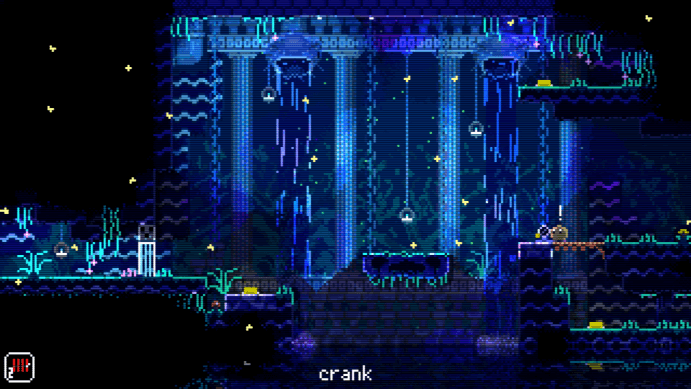
Solving puzzles does not rely on the props column, but on the understanding of the environment. There was an area that was always dark. I tried to move forward with a candle, but the light would alarm the nocturnal creatures living here. Later, I found that as long as the candle was blown out, those creatures would be quiet, and their eyes would emit faint fluorescence in the dark — it was these points of light that connected to the path to the next area. Another puzzle needs sound: I found a bell and shook it, and the flowers in the distance will resonate and bloom, revealing the passage inside. The game never explains these connections. It just puts the elements there and waits for you to find the hidden dialogue between them.
With the deepening exploration, I found that there are multiple cognitive levels in the world. At first, I thought it was just a beautiful maze, but later I found hidden runes in the pixel gaps of the wall. When I gathered the runes and opened a secret door, there was a completely different spatial logic inside — the speed of time flow changed, and the direction of gravity also changed. And the latest discovery suggests that there may be secrets on the third and fourth layers. This kind of design is not difficult, but inviting: it gently tells you that the world is deeper than you think, and every moment you break through the cognitive boundary is the best reward given to you by the game.
There was no battle, no escalation, but the tension never disappeared. The tension comes from the awe of the unknown: I know that there is beauty hidden in this darkness, and there may also be danger; I know that taking a wrong step may be lost, but retreating means missing a certain possibility forever. There are few props in the backpack — a bubble that can float briefly, a key that can open a specific flower, and a mirror that can reflect light — but everything becomes crucial to be in the right place. They are not weapons, but extensions of the senses, which help me see more of the world.
I haven’t “cleared customs” so far. There may never be a so-called customs clearance. Because every time I go back to the area I have explored, I will find details that I have ignored before: the cracks on the wall turned out to be clues to the map, and the star map somewhere in the background corresponds to the organs of another area. This ecological maze is like real nature, which is always secret.
After exiting the game, I looked at the floating jellyfish in the screen saver and suddenly felt that they had some similarities with the creatures in _Animal Well_ — quiet, self-sufficient, and existed in a way that humans could not fully understand. This game did not give me the joy of conquest. It gave me another more lasting satisfaction: the moment of listening in silence, waiting in the dark, and finally reaching a brief tacit understanding with a strange life. In this era of pursuing speed and excitement, it gently reminds me that sometimes, the deepest exploration is not to move forward, but to learn to be a glowing eye that can only be quietly observed and patiently in a deep well-like world.