When I “woke up” from the oven, the world was a three-dimensional book cut from cardboard. My body is soft. If I jump a little harder, I will bounce twice on the ground. If I poke my finger into my arm and pull it out, it will leave a small pit that will slowly bounce back. I made the dough. My name is Loaf, a dough-man who was accidentally given life in the bakery. My creator — the panicked baker’s father — gave me the first task not to save the world, but “don’t put flour everywhere”. _Born of Bread_ set the tone from the beginning: this is an absurd comedy that deconstructs all heroic legends with innocence.
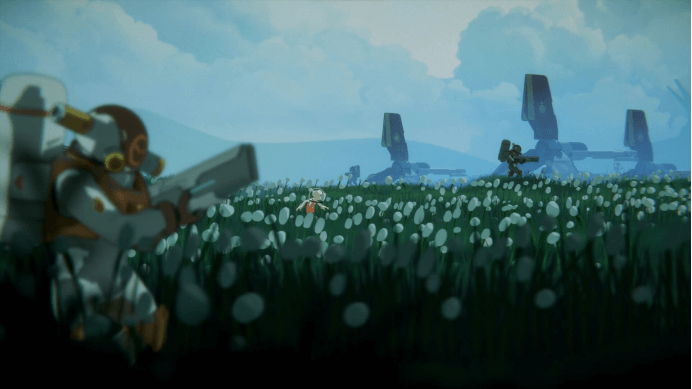
Moving itself has a comedic effect. When I start running, my body will shake slightly, like a pudding trembling on the tray; when I land from a high place, I will spread it into a cake shape with a “poof”, and then slowly return to its original state. The world is a bright paper art style. The trees are like colored paper, the clouds have obvious paper patterns, and even the sunlight is like the light reflected by gold foil paper. This handmade texture makes everything look cute and unreal, as if you can tear off the next page and rewrite it at any time. And my dough body has become the most reasonable existence in the world — after all, in the world of paper, what’s so strange about a walking dough?
The ability to design is full of nonsense ideas. My “battle” is not to swing a sword to cast spells, but to throw sticky dough to smear the enemy’s eyes, or stretch myself into a slingshot to launch my teammates. When solving the puzzle, I can reach the lever in the distance, or flatten myself into a thin piece and slip under the crack of the door. The funniest thing is the “fermentation” skill: hold a breath to make yourself expand and bigger, which is used to suppress the switch or block the rolling boulders. Every time these abilities are used, the companions will show “Can this also be done?” The funny expression, and the enemy is often dizzied by this unreasonable way of playing cards.
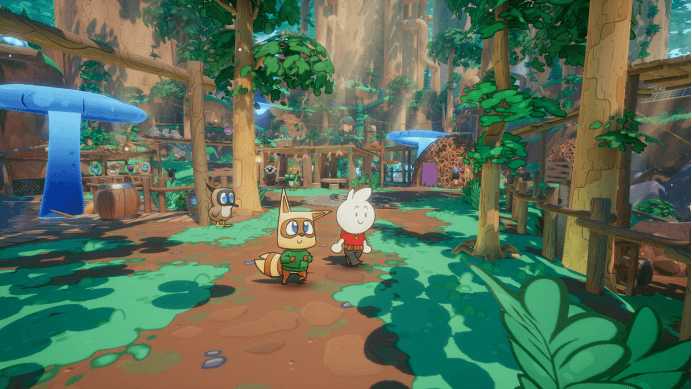
NPC’s dialogue is the core of humor. Every character I meet has an exaggerated personality: a melancholy mushroom poet recites sonnets about wet soil all day long; a group of squirrels who think they are from the Royal Guard insists on checking my “grain pass”; and a retired adventurer snail, whose heroic stories are all about how to spend three days climbing. Pass by a fallen leaf. The dialogue option is often an innocent Loaf-style reaction: “Can we play together?” “Can you eat that shiny thing?” And the world’s reaction is always both helpless and gentle — after all, who can be angry with a life that has just been born and is still full of softness and curiosity about the world?
As the adventure unfolded, this innocence began to touch a deeper topic. We passed by a “efficiency town” managed by machinery., where everything was terribly standardized: the houses were exactly the same, and the residents were counting the steps as they walked. Loaf didn’t understand the rules. He just thought that “everyone doesn’t laugh, it’s strange”, so he began to dance the dough dance he invented in the square. At first, no one cared about him. Later, a child secretly wriggled with him, and then the whole square couldn’t help laughing. The game asks questions in the softest way: When the world becomes too serious, does it need a life that does not know the rules to remind us that happiness does not need a reason?
The secrets of the world of paper art are also gradually unfolding. I found that some folds in the background can really be “turned over” to reveal hidden areas; some of them look like decorative gears, but they can actually be removed and assembled into keys. What touched me most was the scattered recipe pages — every time I found a page, the baker’s father would try to make it in the kitchen. When he finally succeeded after many failures, he would somehow deliver the finished product to me in the adventure. It’s not a magical prop, it’s just a slightly burnt cookie, but it can provide warmth in the cold cave and restore physical strength when you’re tired. Fatherly love has become the most practical magic.
The final climax of the game is not to defeat the demon king, but to hold a grand bread festival. The mushroom poet who had helped came to recite, the squirrel guard maintained order, and the residents of the efficiency town brought standardized but carefully made pastries. Even the snail adventurer arrived on time (although he was two days late). Loaf stood in the middle, still the soft and silly dough-man. He didn’t become a hero. He just made everyone who had seen him a little like him and was willing to believe in a little bit of impossible beauty.
After quitting the game, I looked at the half-eat bread on the table and couldn’t help laughing. _Born of Bread_ did not give me a deep philosophy or exciting battle. It gave me a whole afternoon of giggling and a gentle reminder: maybe every life was originally a soft dough, and the world baked us into various shapes. But occasionally, we can still remember the primitive, resilient courage to touch everything with innocence — even if it’s just a happy dough-man in the virtual paper world.