When I first climbed the yellow smoke chimney, the whole world spread out into a stained puzzle under my feet. The rusty pipes are like the intestines of giants, the abandoned containers are piled up into crooked mountains, and the faded smiles on the billboards in the distance are melting in the rain. The character I control — a paint spray gangster who doesn’t even have a name — is squatting on the edge of the chimney, with several cans of spray paint and a wrinkled map stuffed in his backpack. There is no task list, no experience bar, only an impulse to leave something in every corner of this industrial ruins. _Sludge Life_ gives me not a goal, but a state: a kind of rebellious sobriety roaming between garbage and graffiti.
Mobile itself is a game. I can climb ladders, climb walls, jump to the top of containers, and even use some hidden spring cushions to jump to unexpected heights. The island is small, but the vertical space is fully utilized. Every ventilation pipe may lead to the secret, and every rusty staircase may lead to a strange man squatting in the shadow. What fascinates me most is the “aimless” freedom: I may have wanted to find a wall to spray paint, but I was attracted by a flashing TV screen in the distance. When I walked over, I found that it was an abandoned store playing abstract animation. There was a man wearing a gas mask sitting in it, and he would only make strange gestures to me.
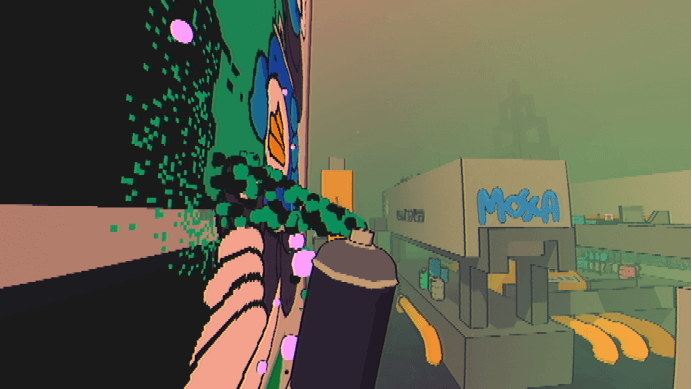
Spray painting is a way to leave traces. Find a suitable wall, choose a pattern, and hold down the spray button. The sound is very real, the hiss of the pigment covering the rough surface. Patterns rot from simple labels to complex little monsters, and it’s up to me to spray anywhere. Sometimes it’s just to mark “I’ve been here”, and sometimes it’s just to complete the “combination graffiti” commissioned by a mysterious person — spray a specific pattern on a specific three-sided wall, and then go back to the commissioner. The person may give me a key to a new apartment, or just nod and say “cool”. The reward is never gold coins or equipment, but more permission to enter this muddy world.
The residents of the island live in absurdity. There was a guy talking to the vending machine all day long, thinking that it was imparting wisdom; a woman lived in a container full of old TVs, insisting that all programs were sending her encrypted messages; and a group of people wearing animal head masks were holding a never-ending party in the parking lot. There are very few options for dialogue with them, often only “...” or one or two vague responses. But it is this sense of alienation that constitutes the unique humor of the game — we are all in this garbage dump, each carrying out incomprehensible rituals.
The visual style is low-fidelity aesthetics. The model is rough and the picture is blurry, but the color is a highly saturated fluorescent color, like looking at a dying world with a cheap filter. The soundtrack is a lazy electronic beat, sometimes mixed with environmental noise: the roar of machines in the distance, the sound of raindrops hitting the tin, and the radio noise coming from nowhere. All this is combined to form a strange sense of immersion: you not only feel dirty and depressing here, but also inexplicably feel a sense of belonging. Maybe it’s because this sludge is honest enough — it never pretends to be anything else.
As I explored, I found all kinds of secret tapes. Play them, some are psychedelic music, some are someone’s monologue fragments, talking about the boredom of consumer society, or thinking about the essence of creation. These fragments are not put together into a complete story, but like scattered mirrors, reflecting the spiritual core of the island: a kind of voluntary exile, a kind of persistence in finding meaning in the ruins.
I finally climbed to the top of the highest communication tower on the island. Looking down, those pipes, containers and graffiti walls are all reduced into an abstract pattern. The wind was so strong that my character silently lit a cigarette (it was really just a cigarette in the game). There is no ending animation, and there is no list of producers. I can choose to jump down or climb down to continue roaming. I chose the latter because I know that in this world that refuses to be beautified, the real rebellion is not to leave, but to stay and continue to draw your own meaningless beautiful patterns on its skin.
After exiting the game, the neon lights of the city outside the window suddenly looked a little too neat. _Sludge Life_ makes me miss that virtual muddy field. It reminds me that sometimes, the most gentle resistance to the system is not to smash it, but to find a corner for yourself in its cracks where you can squat down, spray some color, and then quietly watch the smoke rise. Because in such a corner, freedom is not a slogan, but a way of breathing.