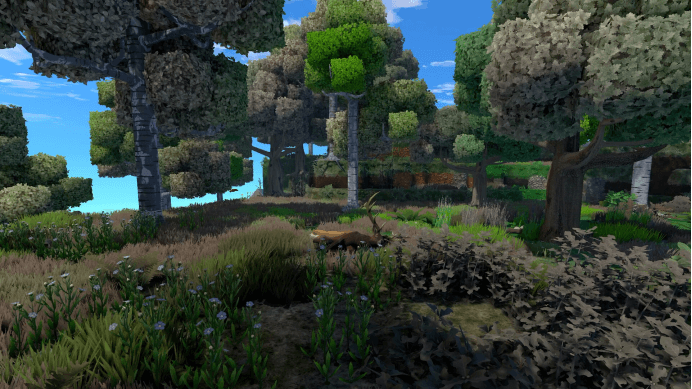
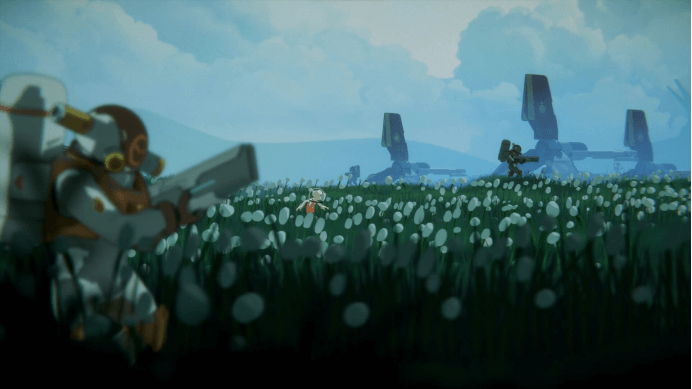
The first time I raised the telescope, the robin standing on the dead branch just fell down. There was no sound, no struggle, just fell straight into the stream below like a fallen leaf. The environmental sampling bottle in my hand is still empty, but I know that it no longer needs to be tested — the stream has an unnatural pearl luster, and the sweet smell in the air is like rotten flowers. _The Forest Cathedral_ did not give me a weapon or a list of tasks. It only gave me the name of a researcher, a set of sampling tools, and a dying forest. And my task is to record the death and decide whether to become its accomplice.
The forest itself can speak, but it uses another language. The plaque pattern on the bark, the deformed angle of the insect wings, and the sudden silence of the bird’s nest — every detail is a testimony. The core interaction of the game is “observation and recording”: I take pictures of mutant fungi with a camera, collect abnormal insect sounds with recording equipment, and sketch the abnormal behavior of animals on the logbook. This is not to solve a mystery, but to construct an irrefutable chain of evidence. The most suffocating things are those human traces: pesticide tanks half hidden in the dirt, rusty warning signs, and truck ruts pointing to the depths of the forest. You don’t need a text description. The forest itself is accusing.
Choose to appear in silence. When I found the first water pollution point, the game gave me two blank labels. One wrote “industrial leakage” and the other wrote “natural acidification”. If you choose the former, the log will generate a report pointing to a nearby chemical plant; if you choose the latter, the data will lead to a fictional “geological activity”. There was no systematic punishment, only my own eyes kept seeing more dead fish floating by the streams labeled as “natural acidification” in the subsequent journey. The game doesn’t judge. It just makes every choice of self-deception become an increasingly tight rope in the subsequent narrative.
As I went deeper, I met other “roles”: an old ranger who insisted that the forest was just a “cyclical disease”, a child who secretly buried dead animals, and an elegant lobbyist representing a chemical company. The conversation with them is not a branch option, but a choice of cognitive framework. The same evidence can be interpreted as “natural fluctuations requiring long-term observation” or as “ecological crisis of immediate intervention”. Every time we go back to the forest after a conversation, those trees look slightly different — either more like victims or more like “adapting life forms”. The cruelest design of the game is that it makes you realize that the so-called objective facts are often just a reflection of the choices you have made.
The climax happened when I found the hidden research file. It records that my role — the researcher — actually submitted an early warning report three years ago, but the report was modified, the data was diluted, and she was finally fired for “academic misconduct”. The disaster I have been investigating turned out to be everything my predecessor tried to stop. This discovery covers all sampling, records and choices with tragic irony: am I exposing the truth or repeating a doomed ritual?
There is no ending in the game to save the forest. Before the final report was submitted, the system asked me for the last time: whether to delete all data pointing to specific companies and change the conclusion to “multiple complex factors caused”? I looked out of the window — the forest in the game showed a dying beauty in the twilight, and the edge of my screen reflected the safe and bright room in my reality.
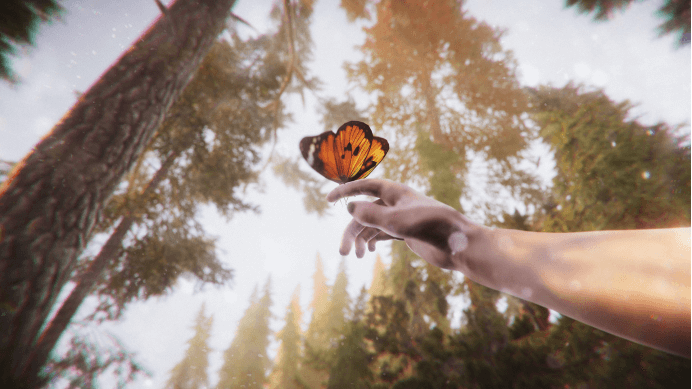
I chose to keep all the data, even though I knew that this line of text would probably only be a byte that no one consulted in a database. When the submit button was pressed, the forest was not resurrected, but the rogin that died at the beginning suddenly flapped its wings again in the memory.
After quitting the game, I went to the kitchen to pour water. The liquid flowing out of the faucet is clear and transparent. But for the first time, I realized so clearly that behind every drop of “safe” water, there may be a dead forest that no one can see. _The Forest Cathedral_ did not give me the slogan of environmentalism, but gave me a pair of lenses that I could never take off again. Through it, every daily choice becomes a micro-scene of ecological ethics: do you want to use this paper for the second time? Do you want to turn off the light one minute earlier? Each of us is a researcher in the forest, holding an invisible sampling bottle, writing our own silent report every day. And the real courage may not be shouting loudly, but still choosing to write the epitaphs it deserves for the robin that can no longer make a sound at the moment when there is no supervision.